
Algerian court sentences Kamel Daoud and his wife to five years in absentia over Houris
The Goncourt-winning novelist and his wife, Aicha Dahdouh, both living in France, were convicted of disclosing medical secrets and invading the privacy of a woman who says the book tells her story.
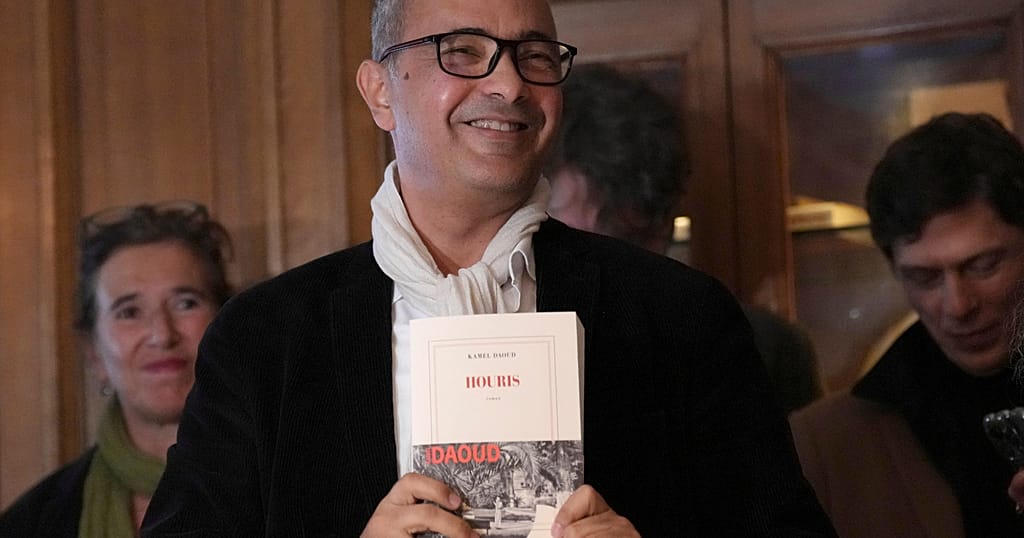
An Algerian court on Tuesday sentenced the award-winning writer Kamel Daoud and his wife, Aicha Dahdouh, to five years in prison each. Both live in France and were tried in absentia.
According to the Algerian daily El Khabar, the couple were found guilty of disclosing medical secrets and invading privacy. The prosecution concerned Houris, the novel that earned Mr Daoud the Prix Goncourt, France's most prestigious literary award, in 2024. The book follows a woman who loses her voice after an Islamist slits her throat during Algeria's civil conflict of the 1990s.
A patient's complaint
The case was brought by Saada Arbane, an Algerian woman who says the novel unlawfully drew on details of her life that she had shared with Ms Dahdouh, who was at the time her psychotherapist. Her complaints point to a series of similarities between her own experience and that of the book's narrator, including a breathing tube, a slashed throat, a matching scar and tattoos, and the hair salon that both women ran.
Mr Daoud, a columnist for the French magazine Le Point, has denied that the novel relies on confidential information drawn from Ms Arbane's life. Ms Dahdouh has also rejected any wrongdoing, although she has acknowledged that she treated Ms Arbane as a psychotherapist in Algeria.
A second conviction
This is the second time the writer has been convicted in Algeria in connection with Houris. In a separate case in April, he received a three-year prison sentence over the same book.
The latest ruling comes as the couple's relationship has broken down. In a statement sent to AFP last month, Ms Dahdouh distanced herself from her husband, saying his "voice should not silence" her own and that she disagreed with him on three essential questions: Algeria, Islam and Palestine. In an interview published on Monday by the French outlet Mediapart, she said the two had begun divorce proceedings.